

Living in a Dubai Community: The Complete 2026 Resident Guide to Harmony and Governance

Updated: Apr 2
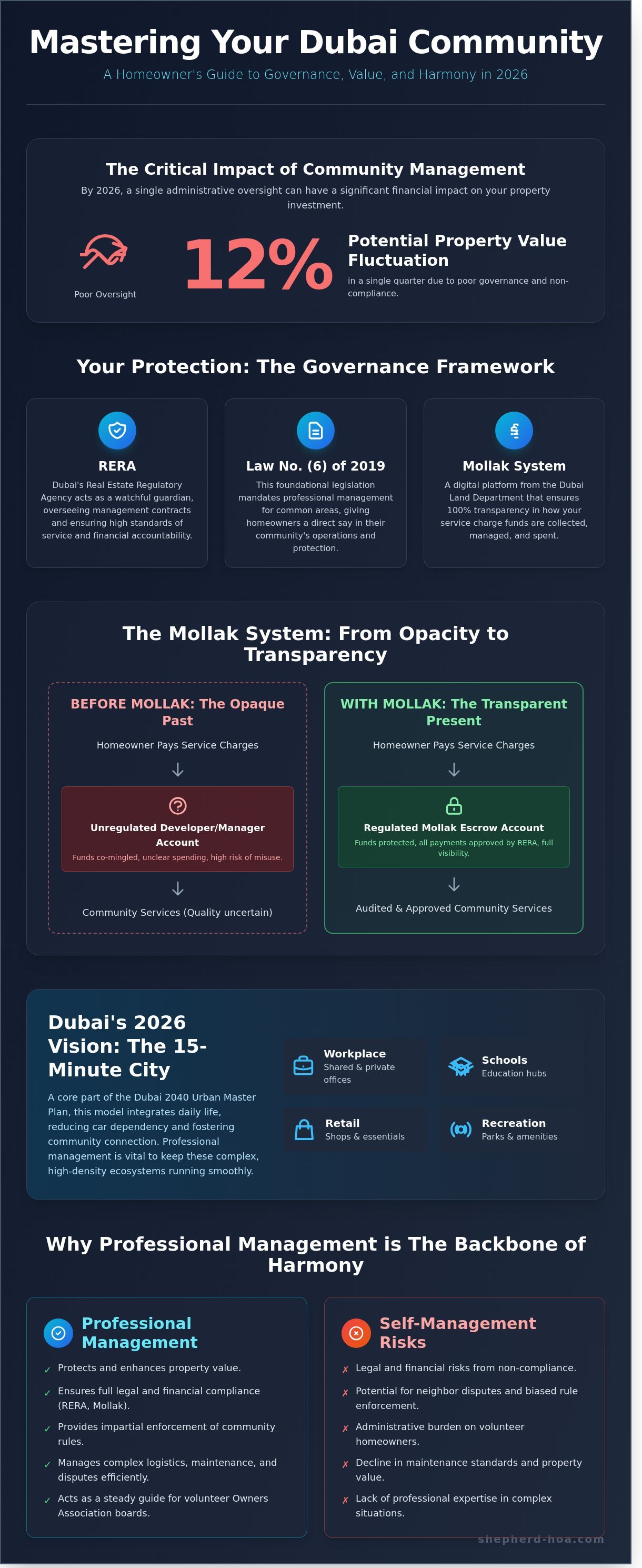
By 2026, a single administrative oversight in your community governance can fluctuate your property value by as much as 12% in a single quarter. You likely chose your home for the promise of a seamless lifestyle, yet you're probably tired of the opaque nature of service charge hikes and the persistent confusion surrounding RERA compliance. It's frustrating when the amenities you pay for aren't maintained to the high standard you were promised. We understand that living in a dubai community should feel like a sanctuary, not a source of constant administrative stress or financial surprises.
This guide empowers you to regain control over your residential experience by mastering the complexities of the Mollak system and your legal rights as a homeowner. You'll learn how to ensure every AED 1,000 you spend on service charges translates into tangible value and pristine common areas. We'll walk you through the latest 2026 regulatory updates, provide clear steps for resolving neighbor disputes, and show you how to foster long term harmony through transparent governance. It's time to replace uncertainty with the organized control you deserve.
Key Takeaways
Gain financial peace of mind by understanding how Law No. (6) of 2019 and the Mollak system ensure every AED of your service charges is managed with full transparency.
Discover how the 2026 shift toward the 15-minute city model is transforming the daily experience of living in a dubai community into a seamless blend of work and home.
Learn to navigate the Master Community Declaration to effectively balance your personal lifestyle choices with the collective rules of your neighborhood.
Identify the specific roles of Facility and Community Management to ensure your maintenance requests and neighbor disputes are resolved through the correct professional channels.
Understand why professional oversight serves as a protective guardian for your property value, shielding your community from the legal and financial risks of self-management.
Table of Contents The Evolution of Living in a Dubai Community in 2026 Understanding the Governance: RERA, Mollak, and Your Service Charges Common Area Rules and the Owners Committee: Myths vs. Reality Navigating Daily Life: Maintenance, Disputes, and Community Harmony Why Professional Management is the Backbone of Harmony
The Evolution of Living in a Dubai Community in 2026
By 2026, the definition of living in a dubai community has transformed from a simple real estate choice into a commitment to a specific lifestyle ecosystem. Modern master-planned developments in the UAE are no longer just clusters of villas or apartments. They've become self-sustaining micro-cities. Residents in 2026 prioritize the "software" of their neighborhood; the governance, the social cohesion, and the management standards; as much as the physical "hardware" like pools or fitness centers. This shift reflects a maturing market where long-term stability and community harmony are the primary drivers of property value.
Governance has emerged as the new luxury. Homeowners now look for neighborhoods where administrative tasks are handled with professional precision and transparency. This regulatory clarity is overseen by Dubai's Real Estate Regulatory Agency (RERA), ensuring that every community follows strict guidelines for transparency and financial accountability. A management company in 2026 acts as a shepherd, protecting the collective interests of the owners while maintaining the high standards that define the Dubai brand. It's about moving from reactive maintenance to proactive community stewardship.
The 15-Minute City: Dubai’s New Urban Standard
The 2026 urban landscape follows the 15-minute city model, a core tenet of the Dubai 2040 Urban Master Plan. In flagship developments like Dubai Hills Estate and Dubai Creek Harbour, residents can reach their workplace, schools, and essential retail within a 900-second walk or cycle. This integration reduces reliance on cars and fosters a deeper connection to the local environment. Because these hubs are high-density and high-activity, they require professional management to oversee complex logistics. From managing shared workspaces to coordinating integrated retail logistics, the role of a management entity is vital to keep these ecosystems functioning without friction.
Master Developers vs. Owners Associations
There's a clear distinction between the master developer, such as Emaar or Nakheel, and the management entity that handles daily operations. While the developer builds the infrastructure, the responsibility for long-term maintenance eventually shifts toward Owners Associations (OAs) or Management Boards. By 2026, more communities have transitioned from developer-led control to homeowner-led committees. This transition allows residents to have a direct say in how their service charges, often ranging from AED 12 to AED 30 per square foot, are allocated.
Shepherd HOA facilitates this transition by providing the administrative structure and technological tools necessary for board members to lead effectively. We act as a steady guide for volunteer boards, helping them navigate fiduciary duties and compliance requirements without the typical stress of manual oversight. Our platform ensures that financial records are clear and CC&Rs (Covenants, Conditions, and Restrictions) are enforced fairly. This organized approach protects the community’s assets and ensures that living in a dubai community remains a seamless, high-value experience for every resident. By replacing administrative headaches with intuitive systems, we help maintain the harmony and property values that homeowners expect in a world-class city.
Understanding the Governance: RERA, Mollak, and Your Service Charges
When you choose the lifestyle of living in a dubai community, you're entering a regulated ecosystem designed for your protection. Law No. (6) of 2019 serves as the foundation for this structure. This legislation, enacted in September 2019, effectively transferred the management of common areas from developers to specialized management companies. It ensures that homeowners have a say in how their building or villa cluster operates. The Real Estate Regulatory Agency (RERA) acts as a watchful guardian, overseeing every management contract to prevent service quality from dipping while costs remain high. This legal framework isn't just bureaucracy; it's the invisible backbone that maintains the harmony and value of your investment.
The Mollak System: Your Shield Against Financial Opacity
The Dubai Land Department (DLD) launched the Mollak system to bring absolute clarity to community finances. Before this digital transformation, owners often struggled to see exactly how their dirhams were spent. Now, Mollak prevents developers from co-mingling community service charges with their own corporate accounts. Every dirham you pay is tracked through a system that requires independent audits. Every invoice you receive is pre-approved by RERA after they verify the community's budget. This means the 15 AED or 25 AED per square foot you pay has been vetted against actual vendor contracts. Paying through these official channels is the only way to safeguard your ownership rights. It's a seamless process that replaces guesswork with verified data, ensuring that 100% of your contribution stays within your community.
General Fund vs. Reserve Fund
Your service charge invoice isn't a single flat fee; it's split into two distinct buckets that serve different purposes. The General Fund covers the daily heartbeat of the neighborhood. This includes the 24/7 security teams, the daily pool chemical balancing, and the landscaping that keeps your surroundings lush. In high-rise towers, utilities like DEWA for common areas can account for nearly 40% of this fund. It's the money that keeps the lights on today.
The Reserve Fund, often called a sinking fund, is your long-term insurance policy. It's a dedicated pot of money set aside for major capital repairs that occur every 10 to 15 years, such as replacing central chiller units, upgrading elevator mechanics, or repainting the entire building exterior. A healthy reserve fund is the most reliable protector of your property's resale value. If a community lacks these savings, owners face "special levies" or "emergency collections" when a major system fails. These unexpected costs can reach tens of thousands of dirhams per unit, which can tank property prices overnight. A well-managed community typically aims to keep its reserve fund at 15% to 30% of the total annual budget to ensure long-term stability.
To verify if your fees align with market standards, you should consult the RERA Service Charge Index. This tool provides a transparent benchmark for every major project in the city, allowing you to compare your costs against similar developments. If your community's costs seem skewed or the management feels disorganized, it might be time to suggest a more transparent management approach to your board. Living in a dubai community should feel like a partnership where your financial contributions are respected and efficiently utilized. By understanding these governance tools, you move from being a passive payer to an informed stakeholder in your neighborhood's future.
Common Area Rules and the Owners Committee: Myths vs. Reality
The Master Community Declaration (MCD) serves as the legal foundation for your neighborhood. It's a comprehensive document registered with the Dubai Land Department (DLD) that outlines how every square meter of the development should be used. When you're living in a dubai community, you aren't just buying a villa or an apartment; you're entering into a collective agreement to maintain a specific standard of living. This "constitution" ensures that your neighbor cannot paint their house a disruptive color or leave debris in shared hallways, protecting the aesthetic integrity of the entire area for everyone.
Some residents view community rules as overly restrictive or unnecessary. This is a common misconception that ignores the financial benefits of order. Data from local real estate analysts indicates that communities with strictly enforced guidelines see property values remain 12% to 18% higher than those with lax governance. These rules balance your personal freedom with the right of every resident to enjoy peaceful, clean surroundings. By preventing neighborhood decline, these standards act as a protective shield for your most significant investment.
Living in a dubai community means sharing high-end amenities like temperature-controlled pools, modern gyms, and landscaped parks. The rules governing these spaces ensure that one person's enjoyment doesn't come at the expense of another's peace. Whether it's a limit on the number of guests at the pool or specific hours for gym usage, these parameters are designed to prevent overcrowding and wear. They're the invisible backbone of a harmonious neighborhood.
Navigating Community Rules and Regulations
Standard regulations focus on visible harmony and noise control. For instance, most communities prohibit hanging laundry on balconies or installing non-approved window tints. Pet owners must adhere to Dubai Municipality guidelines, which often include mandatory leashing and waste disposal in common areas. Noise levels are typically regulated between 10:00 PM and 8:00 AM to ensure residents get adequate rest. Enforcement follows a structured path according to Law No. (6) of 2019. It usually begins with a friendly notification, followed by a formal warning. If non-compliance continues, the management can escalate the matter through the Mollak system, which may result in fines starting from AED 500 and reaching up to AED 2,000 for persistent issues.
The Power and Limits of the Owners Committee
The Owners Committee (OC) acts as the bridge between residents and the management company. Comprising 3 to 9 elected members, the OC has a fiduciary duty to act in the best interest of all owners rather than their own personal agendas. They don't have the power to change laws or unilaterally fire staff, but they provide critical input on service provider selection and budget approvals. Joining the OC is the most direct way to influence your neighborhood's future and ensure transparency in how your service charges are spent. Shepherd HOA supports these committees by handling the complex administrative compliance required by RERA. We manage the 30+ recurring tasks that often overwhelm volunteer boards, providing the expert guidance needed to keep the community running smoothly and without stress.
Navigating Daily Life: Maintenance, Disputes, and Community Harmony
Success in a managed environment depends on your ability to distinguish between Facility Management (FM) and Community Management. FM providers handle the physical infrastructure like elevators, swimming pool chillers, and common area lighting. Community Management acts as the administrative brain. They oversee the FM contracts, manage the budget, and enforce the community rules. When your AC fails in the lobby, it's an FM issue. When a neighbor constantly blocks your driveway, it's a Community Management matter. Understanding this distinction ensures you reach the right person quickly, making living in a dubai community a far more efficient experience.
Managing the logistical flow of your home requires planning. Dubai developers and management companies require a No Objection Certificate (NOC) for every move-in or move-out. You'll typically need to submit this request 48 hours in advance through a dedicated portal. Most communities require a refundable security deposit, often ranging from AED 1,000 to AED 2,000, to cover potential damage to lifts or hallways during the move. Ensuring your service charges are paid in full is a prerequisite for receiving these permits. This structure protects the property's value and ensures that common areas remain pristine for everyone.
Resolving Neighbor and Common Area Disputes
Conflicts are inevitable, but they don't have to be stressful. If a neighbor's noise exceeds acceptable levels after 10:00 PM, start with a friendly conversation. If the issue persists, document the incident and contact the on-site security team. They provide a neutral third-party observation that is vital for formal reports. Community managers act as mediators under Law No. (6) of 2019, which governs jointly owned property in Dubai. They aim for a 100% resolution rate at the local level. You should only escalate a case to the Dubai Land Department (DLD) or the Rental Dispute Center if mediation fails and the violation of the community declaration is clear and documented.
Maintenance and Service Standards
High-quality living in a dubai community is defined by the Key Performance Indicators (KPIs) set by the board and management. Security teams aren't just guards; they're the first line of safety, often required to perform patrols every 60 minutes. Waste management schedules usually dictate daily collections to maintain hygiene standards in the desert heat. Service providers are selected through a competitive tendering process every one to three years. This ensures the community receives the best value for its service charge budget. A healthy neighborhood typically maintains a 95% satisfaction rate on common area cleanliness and a response time of under 30 minutes for emergency maintenance calls.
Community events play a functional role beyond simple socializing. Whether it's a seasonal market or a fitness challenge, these gatherings transform a collection of houses into a cohesive neighborhood. When residents know each other, they're 40% more likely to resolve minor grievances privately. This social glue reduces the administrative burden on the board and creates a protective environment where everyone looks out for one another. It's about building a sustainable ecosystem where property values and quality of life grow together. It's this sense of belonging that truly turns a property into a home.
To streamline your board's oversight and ensure these standards are met,
.
Why Professional Management is the Backbone of Harmony
Successful living in a dubai community depends on more than just shared swimming pools or landscaped gardens; it relies on the invisible infrastructure of professional management. Many homeowners associations initially consider "self-management" to save on costs, yet this often leads to expensive legal and financial pitfalls. In Dubai, Law No. (6) of 2019 establishes a strict framework for jointly owned properties. Volunteer boards who attempt to manage these complexities without expert guidance frequently face 15% to 20% higher delinquency rates in service charge collections. This happens because volunteers lack the formal enforcement mechanisms and specialized legal knowledge required to navigate RERA regulations effectively.
Professional oversight acts as a shield for the community's financial health. When a management partner handles the daily administrative burden, it allows board members to focus on high-level decision-making rather than chasing late payments or debating plumbing quotes. Effective management ensures that every 1,000 AED allocated to preventive maintenance today prevents 5,000 AED in emergency repairs three years down the line. This proactive approach is the only way to preserve property values in a competitive market like Dubai, where well-maintained buildings can command a 7% higher resale price than those with visible signs of neglect.
This principle of preserving property value through expert oversight is a global standard. While the regulations discussed here are specific to Dubai, the core benefits of professional property management are universal. For example, firms like Morgan Property Solutions Inc. in the U.S. demonstrate how dedicated management is key to maintaining community standards and protecting homeowner investments, regardless of location.
Shepherd HomeOwners' Association serves as your ethical, RERA-approved partner in this process. We don't just manage buildings; we protect investments. By ensuring full compliance with local laws and maintaining rigorous financial standards, we create an environment where living in a dubai community feels effortless for the residents and stress-free for the board.
The Shepherd HomeOwners' Association's Approach: Peace of Mind for Boards
We handle budget planning with a focus on long-term sustainability, ensuring your reserve funds are prepared for major life-cycle costs like chiller replacements or facade painting. Our team utilizes the Mollak system to provide 100% transparency, meaning every dirham spent is tracked and approved through official government channels. This structured oversight protects the community spirit by removing the friction often caused by financial ambiguity. We balance strict legal compliance with a supportive presence, ensuring your neighborhood remains a peaceful place to live.
Taking the Next Step for Your Community
Evaluating your current management is a vital responsibility for any board. If your current provider hasn't shared a RERA-compliant audit in the last 12 months, or if service charge recovery has stalled below 85%, it's time to consider a change. Switching to a proactive partner like Shepherd HomeOwners' Association is a structured process that typically takes 30 to 60 days. We manage the entire transition, from auditing historical records to updating the Mollak registration, ensuring no disruption to community services.
Ready to bring professional stability to your neighborhood? Enquire about Shepherd HomeOwners' Association's Community Management Services to learn how we can protect your property's future.
Secure Your Community’s Future and Property Value
Mastering the art of living in a dubai community requires a firm grasp of RERA regulations and the Mollak system's transparency. Residents in 2026 expect more than just basic maintenance; they demand rigorous financial oversight and clear communication from their owners committees. Since 2010, Shepherd HOA has acted as a dedicated guardian for UAE neighborhoods, providing RERA-approved management that simplifies complex governance. Our expertise in Mollak financial reporting ensures that every AED of your service charges is accounted for and utilized to preserve long-term property values. We believe that professional management is the invisible backbone of a peaceful neighborhood. It shouldn't be a struggle to manage disputes or maintain common areas when you have a steady guide leading the way. Our team handles the technical compliance and administrative burdens, allowing your board to lead with confidence and clarity. You've invested significantly in your Dubai home, and it deserves the protection of a partner who values integrity above all else.
Your community's best days are ahead when you have the right expertise by your side.
Frequently Asked Questions
Is living in a Dubai community more expensive than a standalone villa?
Living in a dubai community typically involves higher upfront costs because service charges cover shared amenities like 24/7 security, landscaped parks, and swimming pools. While a standalone villa lacks these recurring fees, you'll bear 100% of the costs for your own maintenance and security. In managed areas, service charges usually range from AED 12 to AED 28 per square foot, offering a predictable budget for property upkeep.
Can an Owners Association legally fine me for breaking rules?
Owners Committees don't issue fines directly; instead, the RERA-licensed Management Company enforces rules established in the community's master declaration. Under Law No. 6 of 2019, any financial penalty must be transparent and registered with the Dubai Land Department. Most communities issue two formal warnings before a fine, which can range from AED 500 to AED 5,000 depending on the specific violation and its impact on neighbors.
What happens if I refuse to pay my service charges in Dubai?
Refusing to pay service charges triggers a legal process through the Rental Dispute Center that can lead to a travel ban or a lien on your property. Management companies must provide a formal 30-day notice before taking legal action. If the debt remains unpaid, the authorities can block your ability to sell the unit or renew your residency visa, as these funds are essential for maintaining the building's safety and insurance.
How is the Owners Committee different from a Management Company?
The Owners Committee is a voluntary group of 3 to 9 homeowners who provide oversight, while the Management Company is a professional firm hired to run daily operations. The committee represents the interests of the residents and reviews financial reports. The Management Company handles the technical work like hiring contractors and ensuring RERA compliance. This structure ensures a system of checks and balances to protect your property value.
Can I see the community budget and how my money is spent?
You can access the full, audited financial breakdown of your community through the Mollak portal at any time. Dubai law mandates that management companies submit an annual budget for RERA approval before they issue any invoices. This transparency ensures that 100% of your service charges are spent on approved items like utilities, cleaning, and the sinking fund meant for major future repairs.
What should I do if my community management is unresponsive?
Document your requests in writing and escalate the matter to your Owners Committee if you don't receive a response within 48 hours. If the management company continues to ignore its duties, you should file a formal complaint through the Dubai REST app. This action alerts RERA, which has the authority to audit the company or even revoke its license if it fails to meet its fiduciary responsibilities to the owners.
Are service charges in Dubai expected to increase in 2026?
Market analysts project that service charges will rise by 4% to 8% by 2026 as many of Dubai's flagship communities age and require more intensive structural maintenance. Rising costs for specialized labor and utility inflation also play a role in these estimates. However, RERA's strict audit process ensures that any increase must be backed by concrete data and actual operational needs, preventing developers from raising fees arbitrarily.
How does the Mollak system protect my investment?
The Mollak system protects your investment by routing all service charge payments into RERA-regulated escrow accounts instead of developer-controlled bank accounts. It ensures financial integrity by requiring that 100% of invoices are generated through the official government portal. This oversight guarantees that your money is available for essential services and repairs, which is the most effective way to ensure long-term property appreciation when living in a dubai community.


Comments