
Strata Law in Dubai Explained: A Complete 2026 Homeowner’s Guide
- Sohrab Virani

- Apr 2
- 13 min read
Owning a premium property in the Emirates is a significant financial milestone, yet your investment's long-term value depends entirely on a legal framework most owners find impenetrable. Since the implementation of Law No. (6) of 2019, the landscape of jointly owned property has shifted toward greater transparency, but many residents still struggle to distinguish their rights from their obligations. You deserve to feel like a confident stakeholder in your community rather than a confused bystander. Having strata law dubai explained through a professional lens replaces that uncertainty with a sense of organized control over your assets.
You're right to expect absolute clarity regarding how your service charges are calculated and where those AED are being spent. This guide simplifies the complexities of the 2019 regulations to help you navigate community governance with total peace of mind. As Shepherd HomeOwners' Association, we'll explore the specific roles of the Dubai Land Department and the Mollak system, clarify the division between developer and owner responsibilities, and provide a roadmap for ensuring your community remains a harmonious, well-protected place to live.
Key Takeaways
Learn the essentials of Law No. (6) of 2019 to see how strata law dubai explained protects your property investment and ensures long-term community stability.
Identify the legal boundaries between your private unit and shared common areas to better understand your specific maintenance rights and responsibilities.
Navigate the Mollak system and RERA regulations with confidence to ensure your community’s financial and administrative tasks remain transparent and fully compliant.
Master your rights as a homeowner, from accessing detailed financial audit reports to fulfilling your essential duty in preserving communal property values.
Discover how professional management serves as a steady guardian for your investment, replacing administrative stress with organized control and peace of mind.
Table of Contents What is Strata Law? The Foundation of Jointly Owned Property Decoding the Components: Units vs. Common Areas The Governance Structure: RERA, Mollak, and Owners Committees Homeowner Rights and Obligations: The Practical Side of the Law Professional Management: Your Shepherd Through Strata Compliance
What is Strata Law? The Foundation of Jointly Owned Property
Strata law is the essential framework for shared living in the UAE. It defines the legal structure that governs how owners manage and maintain multi-unit buildings where individual titles exist alongside shared facilities. By understanding how strata law dubai explained impacts your investment, you can move from a state of uncertainty to one of organized control. This legal foundation ensures that while you own your specific apartment or villa, you also hold a collective responsibility for the lobbies, gyms, and swimming pools that make your community functional.
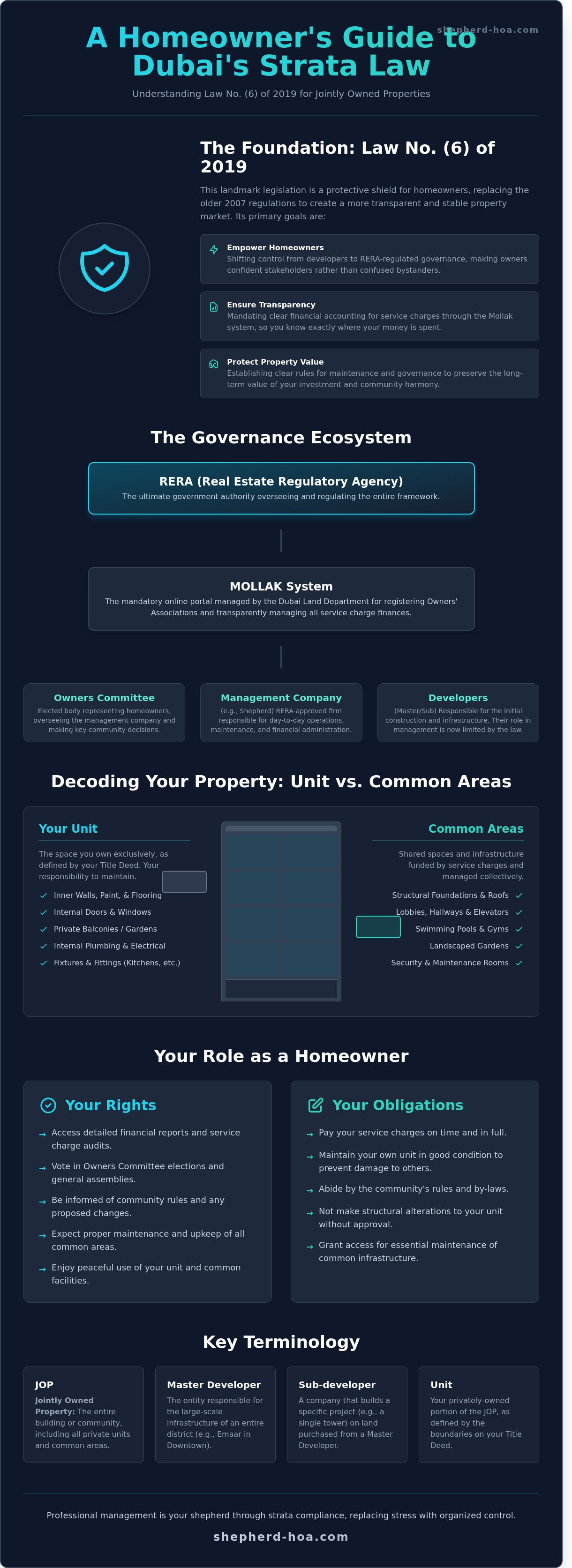
The core of this framework is Law No. (6) of 2019 regarding Jointly Owned Property (JOP). This legislation acts as a protective shield for homeowners. It establishes clear boundaries between private ownership and communal obligations. Before this law took full effect, many owners felt overwhelmed by developer-led management. Today, the law mandates a shift toward RERA-regulated governance. This transition ensures that professional management companies handle community assets with a fiduciary duty to the owners, rather than just the developer's bottom line. Understanding What is Strata Law? is the first step in recognizing your rights to transparent service charge audits and well-maintained common areas.
The Evolution of Property Regulations
Dubai's approach to community management matured significantly when Law No. (6) of 2019 replaced the older 2007 regulations. This wasn't just a minor update; it was a total overhaul designed to increase transparency and investor confidence. The government recognized that for the real estate market to thrive, owners needed to feel like partners in their communities rather than just tenants of a developer. By moving oversight to the Real Estate Regulatory Agency (RERA), the law created a more stable environment for property values to grow. It replaced informal management styles with strict compliance requirements, ensuring every fils of your service charges is accounted for and utilized effectively.
Key Terminology for Every Homeowner
Navigating your rights becomes much simpler when you master the specific language used by RERA and the Dubai Land Department. These terms define your legal standing within the community:
Jointly Owned Property (JOP): This refers to the entire building or gated community where parts are owned privately and other parts, like corridors or gardens, are owned collectively.
Master Developer: This is the primary entity responsible for the large-scale infrastructure of an area, such as Emaar in Downtown Dubai or Nakheel in Palm Jumeirah.
Sub-developer: A company that purchases land from a Master Developer to build a specific tower or project. The law clarifies which developer is responsible for specific maintenance tasks.
Unit: This is your independently owned portion of the project. It's the space defined by your title deed where you have exclusive rights.
By clarifying these roles, the law removes the stress of "who do I talk to?" when things go wrong. It provides a logical path for resolution and ensures that community harmony is maintained through clear legal definitions. When the strata law dubai explained is applied correctly, it acts as a silent backbone for your neighborhood, preserving both your peace of mind and your property's long-term value.
Decoding the Components: Units vs. Common Areas
Understanding where your front door ends and the community begins is the first step toward stress-free ownership. Under Law No. 6 of 2019, the strata law dubai explained framework creates a rigid boundary between private units and shared spaces. Your unit is the area defined in your Title Deed, typically measured from the center of the walls shared with neighbors and the inner surface of external walls. Everything outside this envelope falls under the collective responsibility of the owners.
The law classifies "Common Parts" as any portion of the property not specifically designated for the private use of a single owner. This includes:
Structural foundations, load-bearing walls, and roofs.
Lobbies, hallways, stairwells, and elevators.
Shared amenities like gyms, swimming pools, and landscaped gardens.
Security rooms, storage areas for maintenance, and waste management facilities.
Maintenance responsibilities follow this legal boundary. If a leak occurs within your internal bathroom plumbing, you're responsible for the repair costs. However, if a main riser pipe serving multiple floors fails, the repair is funded through the community service charge. Every building's details are documented in the Land Register at the Dubai Land Department. This register identifies each unit and its "Entitlement," a specific percentage that dictates your voting power and your proportional share of the community's annual expenses.
Ownership Rights in Common Areas
Owners hold an undivided share in common parts based on their unit's size. You don't own a specific corner of the gym; you own a percentage of the entire facility. This means you cannot alter or obstruct common areas, such as placing shoe racks in hallways, without formal approval. The law mandates that developers hand over these common areas to the management entity once the project is registered, ensuring the community gains full oversight of its assets.
Utility and Service Infrastructure
Shared utility systems like central HVAC, water pumps, and fire safety equipment are vital community assets. The developer remains liable for structural defects for 10 years after the completion certificate is issued. For mechanical and electrical equipment, this liability lasts for 1 year. Navigating these timelines is essential during the transition from developer to owner control. You can find more detail on managing this phase in our guide on mastering property handover to ensure no defects are overlooked.
Clear documentation of these boundaries prevents disputes and keeps the neighborhood harmonious. For boards looking to simplify these complex tracking requirements, using an intuitive management platform provides the organized control needed to protect long-term property values.
The Governance Structure: RERA, Mollak, and Owners Committees
Understanding the hierarchy of community management is the first step toward achieving peace of mind as a property owner. The Real Estate Regulatory Agency (RERA) serves as the ultimate supervisor for all Jointly Owned Properties (JOPs) in the emirate. Under Law No. (6) of 2019, RERA enforces strict compliance standards to ensure that developers and management companies operate with full accountability. This oversight is how the strata law dubai explained in practical terms protects your investment from administrative neglect.
Every community must be managed by a RERA-licensed management company. These firms don't just handle the cleaning and security; they act as the legal fiduciary for the property. To prevent conflicts of interest, the law requires an ethical tendering process for all service providers. This ensures that the AED you contribute to the service fund is spent on high-quality vendors rather than preferred partners of a developer. It's a system designed to act as a watchful guardian over your shared assets.
Financial Transparency via Mollak
The Mollak system is the digital backbone of Dubai’s strata framework. It’s a mandatory online portal that handles every financial and administrative task for a community. One of its most vital functions is preventing the co-mingling of funds. In the past, community fees were often mixed with a developer’s general accounts, leading to transparency issues. Mollak ended this by requiring separate, regulated accounts for each project.
You won't receive a valid invoice unless RERA has vetted the community’s budget. Management companies must submit detailed financial plans for approval before any homeowner is billed. RERA checks these costs against market benchmarks to ensure they're fair. For a deeper dive into how this system regulates your payments, see our resource on Understanding Mollak for financial details and compliance steps.
The Role of the Owners Committee
The Owners Committee functions as a consultative body that represents the collective interests of the residents. To be eligible for a seat, you must be a resident owner and remain fully up to date on all service charge payments. This ensures the committee consists of individuals who are personally and financially invested in the community's well-being. The committee typically comprises three to nine members, depending on the size of the development.
While the committee holds significant influence, it's important to understand the legal boundaries. They have the power to review budgets, verify financial reports, and suggest improvements to the way the management company operates. However, they're an advisory group rather than an executive board. The licensed management company remains the party responsible for executing the law and managing daily operations. This distinction ensures that professional experts handle the technical complexities while owners maintain a powerful seat at the table.
Homeowner Rights and Obligations: The Practical Side of the Law
Understanding your role within a master development requires a clear grasp of Law No. 6 of 2019. This legislation ensures you aren't just a resident but a stakeholder with specific protections. Under the strata law dubai explained framework, your primary right is financial transparency. Every homeowner can access audited financial statements and real-time service charge data through the Mollak system. This digital portal, managed by the Dubai Land Department (DLD), acts as a safeguard against the mismanagement of funds. It ensures that every AED you contribute is tracked and utilized for the community's actual needs.
Your most critical legal duty is the timely payment of service charges. These fees aren't optional suggestions. They're the lifeblood of your community's infrastructure. If payments lapse, the consequences are swift. Management companies can apply late fees, and eventually, the case moves to the Rental Dispute Center (RDC). The RDC has the authority to issue an execution order, which might lead to the public auction of the property to recover debts. Maintaining a zero-balance account isn't just about avoiding penalties; it's about protecting the resale value of your asset. A pristine pool and manicured gardens directly correlate to higher market appraisals in areas like Dubai Marina or Downtown.
The law also guarantees your right to a well-maintained environment. If a developer or management company fails to uphold the community's standards, the strata law dubai explained in recent court rulings gives owners the power to demand corrective action. You're paying for the preservation of your property's future, and the law acts as a guardian to ensure those standards never slip.
Service Charge Disputes and Resolution
If you suspect an error in your invoice, don't stop your payments. Withholding funds is a breach of contract that weakens your legal standing at the RDC. Instead, file a formal inquiry through the Mollak system or approach the DLD directly. The law provides a structured path for mediation. Most disputes are resolved through official audits that verify the management company's spending against the budget approved by the DLD.
Community Rules and CC&Rs
Living in harmony requires adherence to Covenants, Conditions, and Restrictions (CC&Rs). These rules govern everything from pet ownership to balcony aesthetics and noise levels after 10:00 PM. The law empowers the Owners' Committee and management to enforce these regulations to prevent a decline in community standards. For practical advice on navigating these daily expectations, read our guide on Living in a Dubai Community.
Ensure your community remains compliant and financially healthy. Partner with Shepherd HomeOwners' Association for expert administrative oversight and peace of mind.
Professional Management: Your Shepherd Through Strata Compliance
Managing a building in Dubai requires more than just hiring a cleaning crew. Under Law No. (6) of 2019, professional management is a mandatory requirement for large-scale developments. It's the only way to ensure your community meets the strict standards set by the Real Estate Regulatory Agency (RERA). Having the strata law dubai explained by a licensed partner helps you see that these rules aren't just red tape; they're the framework for a stable community.
Shepherd HOA acts as your community's guardian, handling the complex administrative tasks that often weigh down volunteer board members. We take the lead on Mollak reporting and RERA audits, ensuring every AED is tracked and every regulation is met. This shift from manual tracking to expert oversight replaces your daily stress with a sense of organized control. We provide the invisible backbone that allows your neighborhood to thrive while we manage the technical heavy lifting.
The Shepherd HOA Approach to Law
We believe transparency is the foundation of a healthy community. Our team manages ethical tendering processes to ensure you get the best value for every dirham spent. We also facilitate transparent budget planning, so homeowners see exactly where their service charges go. Every community meeting and vote we oversee follows the latest 2024 regulatory standards. If you're curious about the structures behind these rules, you can learn more about what is an Owners Association and how we apply our governance philosophy to protect your rights.
Strict adherence to Dubai's Law No. (6) of 2019.
100% compliance with RERA's financial reporting through the Mollak system.
Objective, third-party vendor selection to prevent conflicts of interest.
Protecting Your Investment for the Long Term
Property values in Dubai don't just depend on the market; they depend on how well a building is maintained. Having the strata law dubai explained by experts helps you realize that compliance correlates directly with higher resale prices. We prioritize the Reserve Fund, which is a legal requirement designed to cover major repairs over a 10 year or 20 year horizon. This fund ensures the building's future viability and prevents sudden, massive special assessments that can hurt your finances. By maintaining a healthy reserve and passing every RERA audit, we protect your equity and the physical integrity of your home. You can contact Shepherd HOA today to ensure your community is fully compliant and managed with professional precision.
Mastering Your Dubai Property Investment
Owning a home in the UAE requires more than just holding a title deed; it demands a clear grasp of the regulatory landscape. Having strata law dubai explained through the lens of 2026 standards highlights two vital priorities: precise Mollak system integration and the protection of common areas. These elements ensure your AED investment remains secure while fostering long-term community harmony. Effective governance isn't just about following rules. It's about proactive oversight that prevents administrative friction before it starts.
Shepherd HOA has served as a steady guide for Dubai communities since 2010. As a RERA-licensed partner, we specialize in ethical governance and seamless Mollak management to lift the burden from volunteer board members. We provide the technical backbone your neighborhood needs to thrive under current regulations. You don't have to navigate these complex fiduciary duties alone. Secure your community's future with Shepherd HOA's expert management and experience the peace of mind that comes with professional guardianship. Your property deserves the highest standard of care as we move into a new era of Dubai real estate.
Frequently Asked Questions
What is the main purpose of Law No. (6) of 2019?
Law No. (6) of 2019 regulates jointly owned properties in Dubai to ensure transparency and protect homeowner rights. This legislation introduced the Mollak system to monitor service charges and mandated that developers hand over management duties to specialized companies. It provides a clear framework for community governance, ensuring your investment remains secure under RERA oversight.
Can a developer manage a community indefinitely under Strata Law?
No, developers can't manage a community indefinitely under the current strata law dubai explained here. The law requires developers to appoint a RERA-licensed management company to handle daily operations once the property is registered. This separation of duties prevents conflicts of interest and ensures that community funds are managed by professional third parties rather than the original builder.
What happens if I don't pay my service charges?
Failure to pay service charges leads to legal proceedings through the Rental Dispute Center (RDC). If arrears remain unpaid after a 30-day formal notice, the RDC can authorize the sale of the property at public auction to recover the debt. You'll also face a 1% monthly interest charge on late payments to cover administrative costs and ensure community liquidity.
How do I know if my building's service charges are RERA-approved?
You can verify service charges by logging into the Dubai Land Department's Mollak system online. Every invoice issued must contain a unique RERA approval number and a clear breakdown of the annual budget. If your invoice lacks this specific RERA validation, it's not legally binding. You shouldn't pay it until the management company provides the official certificate for the current fiscal year.
What is the difference between a Master Developer and a Management Company?
A Master Developer like Emaar or Nakheel oversees the entire district's infrastructure, such as roads and main utility lines. In contrast, a Management Company is a RERA-registered firm hired to maintain your specific building's elevators, pools, and security. While the Master Developer sets the overall vision for the area, the Management Company handles the granular, day-to-day maintenance tasks you see every morning.
Can I be a member of the Owners Committee if I don't live in the building?
Yes, you can join the Owners Committee as long as you're a registered owner and have paid all outstanding service charges. Residency isn't a requirement, but you must be a natural person rather than a corporate entity representative. The committee consists of 3 to 9 members who act as the community's voice, ensuring the management company meets its fiduciary duties and maintains high standards.
How does the Mollak system protect my money?
The Mollak system protects your funds by requiring all service charge payments to be deposited into RERA-approved escrow accounts at 7 authorized UAE banks. This prevents developers or management firms from misusing community money for unrelated projects. It ensures that 100% of your contribution stays within your building's budget for essential repairs and long-term reserve funds for the next 10 years.
Who is responsible for repairs inside my apartment vs. the hallway?
You're responsible for all repairs inside your apartment's boundaries, including internal plumbing, electrical fixtures, and paint. The management company handles the hallway, elevators, and structural elements of the building. For example, if a pipe bursts inside your kitchen wall, it's your cost; if the main riser in the corridor leaks, the community's service charge fund covers the repair to protect common areas.


Comments